Saturday, 5 November 2022

10th std Mijbil the Otter

 10th std Mijbil the Otter


 Question Answers


1. How did Maxwell learn of Mijbil’s love for water?

Mijbil loved to play in the water. Only once did the author lead him to the bathroom. Next time he went to the bathroom on his own. He went wild in water, plunged and rolled in e’, He shot up and down the bathtub and made enough slosh and splash in it.


2. Describe some of the games Mij liked to play.

Mijbil invented his own game with a ping-pong ball. He used to keep the basilica lid of the damaged suitcase which when closed, remained at a slope from one end. He to play in the water and also liked to jump and gallop the full length of the 30-yard school well.


3. How did Mijbil pass his time in London?

Mijbil on his way home every day used to tug Maxwell to the low wall of a primary school opposite to his flat. Mij would jump on to it, gallop the full length of its thirty yards and cause a hopeless distraction to both pupils and staff within the primary school.


4. Describe the otter.

The otter was a small creature and it resembled with a medically conceived dragon. It was coated with symmetrical seals at mud from head to the rip at the tail.


5. What are ‘compulsive habits’? What does Maxwell say are the compulsive habits of school children?

Things that one feels competed to do are ‘compulsive habits’. For example, school children try to place their feet on the center of each paving block on the way. They touch every seventh upright of the iron railings. Or, they pass to the outside of every second lamp post.


6. How was ‘Mijbil’ a source of amazement on London streets?

The otter was a constant source of amazement to the London as few had seen an animal as strange as an otter. They were filled with surprise on seeing such an animal. They guessed it with different names of animals.


Answer the following questions in 100-120 words: 

(5 marks)

1. What did Maxwell do to transport Mijbil to England?

After the British Airways refused to take a pet on its flight, the narrator booked a flight to Paris by another airline. This airline insisted that the pet should be packed into a box not more than eighteen inches square, to be carried on the floor near his feet. Maxwell had a box made, and an hour before they started, put Mij into the box so that he would become accustomed to it and then left for a hurried meal. But when he returned he was terrified. There was an appalling silence. Maxwell found blood had trickled and dried around the air holes of the box. He tore open the box to find Mij exhausted, and blood splattered, and whimpering and he caught hold of Maxwell’s leg. However, since he had very little time left to board the flight, Maxwell just put Mij back into the box, holding down the lid with his hand. On the flight, the airhostess, on hearing the author’s tale, permitted him to travel with Mij on his knee. After the initial chaos, Mijbil travelled to London on the author’s knee.


2. Describe the relationship between the otter and Maxwell in your own words.

Maxwell and the otter Mijbil shared a lovely relationship. Maxwell treated Mij like his own son. He took very good care of him. He gave him many toys including marbles, rubber bans, rubber fruits and a terrapin shell to play with. He took him to the bathtub to play in the water knowing the fascination of otters with water. He noticed his habits and traits. Mijbil hesitated on the first day but then became very friendly. Maxwell encouraged Mijbil to do whatever he liked to do. He took him out for exercise every day. When Maxwell saw blood on the box in which Mij was packed, he was horrified. When Mij came out of the box he jumped all over but then came and sat on Maxwell’s knees quietly.


3. How did it come to the mind of the writer that an otter can be substituted for dogs or cats?

The author’s pet dog had died, he was too sad to think of keeping a dog again. Maxwell’s friend suggested him to get an otter from Tigris marshes for they were as common as mosquitoes over there. Moreover, they were often trained by the Arabs. He had to go to Basra to the Consulate-General to collect and answer his mail. His mail had not arrived yet so he had to wait. There he received an otter sent by his friend through two Arabs. The author felt a strong attachment and feelings for it. He liked it and kept it.


4. When did the author decide to have an otter as a pet? How did he get an otter?

The author had a pet dog called Jonnie. When Jonnie died, his life without a pet was lonely. In 1956, he went to Southern Iraq. He had decided by then that he would keep an otter as a pet instead of a dog. His home in Scotland had much water around it. So it would be suitable for an otter. The author shared this idea with a friend. He supported the idea and suggested that he should take an otter from the Tigris marshes. He said that otters were in plenty at that place. One day, the author found two Arabs in his room. They had brought a sack with them. In the sack, there was an otter. They said that it was for him.


5. Describe the author’s experience with the otter in the aircraft. 

When the author reached the airport, the aircraft was wailing to take off. He rushed in. He covered the place with newspaper and gave the parcel of fish to the air hostess for the otter. She cooperated with the author and advised him to keep the pet on his knee. But soon Mij was out of the box. He disappeared very soon. Suddenly, there was chaos in the plane. There were squawks and shrieks all around. A woman cried, “A rat, a rat!” The author saw the otter beneath the legs of an Indian. When he tried to catch the otter, his face got covered in curry. The air hostess assured him that she would find the otter. The author returned to his seat. After some time, the otter came to him and sat on his lap.


6. What were strange and funny wild guesses that Londoners made about Mijbil? Who made the best remark about the otter?

It was rather difficult for an average Londoner to recognise such a strange animal as an otter. Most of them had never seen such a unique animal. The thing that surprised Maxwell that Londoners made such funny and wild guesses about Mijbil, the otter. He faced a continuous barrage of questions from the anxious but ignorant people. They made random guesses about the animal. Some of them guessed that he was ‘a baby seal’ or ‘a squirrel’ or ‘a walrus’. Others also made fantastic guesses. One called Mijbil ‘a beaver’. Another called it ‘a bear cub’. The third guessed that it was `a leopard’. Mij was anything but an otter. A labourer made the best remark about the otter saying “Here, Mister—what is that supposed to be?”


7. Why does he go to Basra? How long does he wait there, and why?

He went to Basra, to the Consultant-General, to collect and answer his mail from Europe. There, he found that his friend’s mail had arrived, but his had not. He sent a message to England. When nothing happened even after three days, he tried placing a call to England. On the first day, the line was out of order; on the second day, the exchange was closed for a religious holiday. On the third day, there was another breakdown. He arranged to meet his friend, who had left, in a week’s time. His mail finally arrived five days later.


8. What happened when Maxwell took Mijbil to the bathroom? What did it do two days after that?

When Maxwell took Mijbil to the bathroom, it went wild with joy in the water for half an hour. It was plunging and rolling in it, shooting up and down the length of the bathtub underwater, and making enough slosh and splash for a hippo. Two days after that, it escaped from his bedroom to the bathroom. By the time he got there, Mijbil was up on the end of the bathtub and fumbling at the chromium taps with its paws. In less than a minute, it had turned the tap far enough to produce some water and after a moment, achieved the full flow.


Extras

1. What things does Mijbil do which tell you that he is an intelligent, friendly and fun- loving animal who needs love?

Mijbil was an intelligent animal. It invented its own game out of the ping-pong balls. It screwed the tap till water began to flow and then it would play and splash in the water. Though it was aloof and indifferent in the beginning, it soon became very friendly. It formed a special attachment with Maxwell. It responded when Maxwell called out his name. It grew desperate when Maxwell left it in a box and it got hurt while trying to come out of it. After Maxwell took it out, it clung to his feet. This shows Mij was an intelligent, friendly and fun-loving animal who needs love.


2. What are some of the things we come to know about otters from this text?

Otters belong to a comparatively small group of animals called Mustellines, shared by the badger, mongoose, weasel, stoat, mink and others. Maxwell’s otter was of a race previously unknown to science and was at length named by zoologists Lutrogale perspicillata maxwelli or Maxwell’s otter. They are found in large numbers in marshes. They are often tamed by the Arabs. It is characteristic of otters that every drop of water must be extended and spread about the place; a bowl must at once be overturned, or, if it would not be overturned, be sat in and splashed in until it overflowed. For them, water must be kept on the move. Otters love playing various games, especially with a ball.


3. Why is Mij’s species now known to the world as Maxwell’s otter?

Maxwell’s otter was of a race previously unknown to science and was at length named by zoologists Lutrogale perspicillata maxwelli or Maxwell’s otter.


4. Maxwell in the story speaks for the otter, Mij. He tells us what the otter feels and thinks on different occasions. Given below are some things the otter does. Complete the column on the right to say what Maxwell says about what Mij feels and thinks.

10th std MADAM RIDES THE BUS

 EXTRA QUESTIONS

Question 1:Why does the conductor call Valli ‘madam’?


Answer:The conductor called Valli ‘madam’ because she was behaving like a woman in an audacious and smart manner. She did not accept his help to get into the bus and was very quick in replying to the conductor’s questions. Amused by her antics and behaviour, the conductor teased her by calling her ‘madam’.


Question 2:Why does Valli stand up on the seat? What does she see now?


Answer:Valli was enchanted by the view of the beautiful scenery outside the bus and was trying hard to look outside. But her view was blocked by the canvas blind that covered the lower part of the window. In order to catch a better glimpse, she stood up on the seat and peered over the blind. She saw the narrow road as the bus was going along the bank of a canal, palm trees, grassland, distant mountains, green fields and the blue sky. On the other side, there was a deep ditch and many acres of green fields stretched far and wide as much as her eyes could see.


Question 3:What does Valli tell the elderly man when he calls her a child?


Answer:When the elderly man in the bus referred to Valli as a child, she instantly replied that there was nobody in the bus who was a child. She further stated that she had paid her fare of thirty paise like other passengers in the bus.


Question 4:Why didn’t Valli want to make friends with the elderly woman?


Answer:Valli was not interested to make friends with the elderly woman because she looked quite repulsive to her. She had big earlobes with bigger holes and wore ugly earrings. Besides, she was also chewing betel nut and her mouth was also filled with betel juice that was likely to spill all over her lips. Seeing all this, Valli thought that the elderly woman was not sociable enough to be friends with.


Question 5:How did Valli save up money for her first journey? Was it easy for her?


Answer:Valli had saved every stray coin meticulously that came her way. She resisted every temptation from buying peppermints, toys, balloons, etc. to save enough money for the bus trip. It had been really difficult for her as she had to control her urges and resisted the temptation to be on the merry-go-round in the village fair. After making a lot of sacrifices, she was able to save sixty paise for her first bus journey.


Question 6:What did Valli see on her way that made her laugh?


Answer:Valli was overjoyed upon seeing a young cow, tail high in the air running very fast right in the middle of the road just in front of the bus. The driver sounded his horn loudly again and again so that the cow moves away from the path. But the more he honked, the cow became more frightened and galloped as fast as possible. Seeing all this, it appeared very funny to Valli and she laughed out loud until tears rolled down her eyes.


Question 7:Why didn’t she get off the bus at the bus station?


Answer:Valli’s plan was only to take the bus ride and not roam around the town. She had painstakingly accumulated sixty paise for her onward and return bus journey. She knew that she had limited money to travel by bus and would spend thirty paise fare on her onward journey, go to the town and then return by the same bus before her mother woke up from her afternoon nap. She neither had the money to roam around the town, nor had she time to explore it, so she didn’t get off the bus at the bus station.


Question 8:Why didn’t Valli want to go to the stall and have a drink? What does this tell you about her?


Answer:Valli didn’t want to go to the stall as she had saved sixty paise only for the bus journey. She didn’t want to waste money on anything unnecessary as she had to return by the same bus at any cost. So, when the conductor suggested her to get down and get a drink for herself, she refused. He also offered to get her a drink in case she doesn’t have money, but she still refused. This implies that she was an independent girl who did not want to rely on anyone for her needs.


Question 9:What was Valli’s deepest desire? Find the words and phrases in the story that tell you this.


Answer:Valli’s deepest desire was to take a ride on the bus that she saw everyday from her house. The words and phrases in the story that depict her desire are ‘an overwhelming desire’, ‘source of unending joy’, ‘stare wistfully’, and ‘kindle in her longings, dreams and hopes’.


Question 10:How did Valli plan her bus ride? What did she find out about the bus, and how did she save up the fare?


Answer:Valli had been carefully listening since many days to the conversations between her neighbours and the people who regularly used the bus and asked a few discreet questions. She learnt from them that the town was six miles away from her village and the bus charged thirty paise as fare for the onward journey and it took forty-five minutes to complete one-way bus trip. She also made up her mind to stay in the bus and return in the same bus that would cost her sixty paise to and fro. She was determined not to get down from the bus to roam around the town as she didn’t have enough money. Hence, she saved sixty paise meticulously and resisted all kinds of urges and temptation to buy peppermints, toys, etc. and even a ride on the merry-go-round at the village annual fair. It was Valli’s secret adventurous bus trip that she had planned without her parents’ knowledge.


Question 11:What kind of a person is Valli? To answer this question, pick out the following sentences from the text and fill in the blanks. The words you fill in are the clues to your answer.


(i) “Stop the bus! Stop the bus!” And a tiny hand was raised ______________________________.


(ii) “Yes, I __________________ go to town,” said Valli, still standing outside the bus.


(iii) “There’s nobody here ______________________,” she said haughtily. “I’ve paid my thirty paise like everyone else.”


(iv) “Never mind,” she said, “I can ___________________. You don’t have to help me. ”I’m not a child, I tell you,” she said, ___________________________________.


(v) “You needn’t bother about me. I ___________________________,” Valli said, turning her face toward the window and staring out.


(vi) Then she turned to the conductor and said, “Well, sir, I hope _________________________.”


Answer:Valli was a confident eight-year-old girl who believed that her age was not a limiting factor for her to travel alone in the bus to the town. She considered herself to be a grown up person and also acted like one.


(i) “Stop the bus! Stop the bus!” And a tiny hand was raised commandingly.


(ii) “Yes, I simply have to go to town,” said Valli, still standing outside the bus.


(iii) “There’s nobody here who’s a child,” she said haughtily. “I’ve paid my thirty paise like everyone else.”


(iv) “Never mind,” she said, “I can get on by myself. You don’t have to help me. ”I’m not a child, I tell you,” she said, irritably.


(v) “You needn’t bother about me. I can take care of myself,” Valli said, turning her face toward the window and staring out.


(vi) Then she turned to the conductor and said, “Well, sir, I hope to see you again.”


Question 12:Why does the conductor refer to Valli as ‘madam’?


Answer:The conductor called Valli ‘madam’ as she behaved like a grown up woman and responded irritably on being referred to as a child. She was an eight-year-old girl and considered herself old enough to travel alone in the bus. Besides, she also refused his help when he extended his hand to help her get into the bus, she replied commandingly that she could manage getting into the bus on her own.


Question 13:Why does Valli refuse to look out of the window on her way back?


Answer:Valli refused to look out of the window on her way back to her village because she was upset on seeing the dead body of the cow that was running towards the bus while she was going to town. The poor animal was hit by some fast-moving vehicle on the road. She was overcome with sadness and extremely frightened to look outside the bus window as the memory of the cow was haunting her.


Question 14:What does Valli mean when she says, “I was just agreeing with what you said about things happening without our knowledge.”


Answer:When Valli’s mother casually mentioned that there are certain things that happen around them without their knowledge, Valli instantly agreed to her mother’s words and said, “I was just agreeing with what you said about things happening without our knowledge.” She was happy about her adventurous bus trip to the town which she had taken without the knowledge of her parents.


Question 15:The author describes the things that Valli sees from an eight-year-old’s point of view. Can you find evidence from the text for this statement?


Answer:Yes, the author had described various things from an eight-year-old’s point of view. Some of these include – ‘she was fascinated by the bus’ and ‘watching the bus fill with a new set of people each time was a source of unending joy for her’. The author described the colour and look of the new bus as ‘its outside painted a gleaming white with some green stripes along the sides. Inside, the overhead bars shone like silver.’ Through this description, the author wanted to express how a child would be attracted towards the colour of the bus. ‘The seats were soft and luxurious’. This description implies that the author wanted to show the excitement of a child to travel in the luxury of a bus for the first time. ‘The blue sky’ and ‘acres and acres of green field’, show the zeal and enthusiasm of a child. Further, when Valli sees the cow running in front of the bus, this fascinated her too whereas the sight of a dead cow brought tears in her eyes. The memory of the cow haunted her and she refused to look outside the window on her return journey. These were some of the lines which beautifully described the typical reactions and behaviour of an eight-year-old child in an ideal manner.


Monday, 31 October 2022

ARTICLE WRITING

 ARTICLE WRITING


POINTS TO REMEMBER

➡️ Understand carefully the clue/information given in the question.

➡️Arrange all the information in an order in which you want them to develop for writing the article.

➡️Use the information provided in the question after interpreting them properly.

➡️Divide your article into several paragraphs. All the sentences in each paragraph should logically lead to the objective for which the article is being written.

➡️The whole composition should not be sketchy. Every sentence should be linked with the rest into a single whole.

➡️The language of an article should be straightforward, to the point, and objective.

➡️Avoid using informal expressions, slang (words which are not used in the literary language), or abbreviations, particularly in persuasive or argumentative articles.

➡️Articles are usually written in the third person.

➡️Adhere to the word limit of 120-150 words.


Sample Article:

Our country is prone to disasters like drought, cyclones, floods, breakage of bridges or earthquakes. Ad hoc measures are adopted to cope with every disaster. The slow response results in loss of human life and property. Write an article for a newspaper giving suggestions about disaster management. 

You may suggest having special equipment, trained personnel, better transport and communication, quick decisions and speedy implementation. Your article should be of 120-150 words. You are Sameer / Sharmistha.

Answer:


DISASTER MANAGEMENT

by Sameer/Sharmistha


Our country is prone to disasters like floods, drought, cyclones, or earthquakes. We do not have any clear-cut policy of disaster management nor any force to tackle the situation. Ad hoc measures are adopted to cope with every disaster. We wait and watch for others to join the fray. 


There are heated arguments over jurisdiction—centre or state liability, official assessment and surveys before any help is rushed out to the affected area. The slow response results in the loss of precious human life and valuable property. We must have clear-cut, well defined guidelines for disaster management. 


A well-trained task-force having special equipment and trained personnel should be constituted. Its controlling officer should have the authority to take decisions and ensure their speedy implementation. Better transport and communication facilities will ensure better results. Bureaucratic set-up should not be allowed to interfere with the work of the disaster-management group.

SPEECH WRITING

 SPEECH WRITING

You are Rudraksha/Rudra, Head girl / Head boy of your school. You are deeply disturbed by the rising cases of aggressive behaviour and indiscipline of students in your school. You have been asked by your teacher to deliver a speech in the morning assembly. Write a SPEECH on ‘Indiscipline in Schools’ in 120 - 150 words.


Answer


INDISCIPLINE IN SCHOOLS


It has been reported that number of fights and cases of bullying has gone up tremendously in the last few months in our school.

Honourable Principal, respected teachers and my dear fellow mates, today, I, Rudraksha/Rudra, your head girl/boy stand before you to throw some light upon the grave issue of “Increasing Indiscipline in Schools”.


The growing indiscipline and intolerance among the new generation is resulting in violation of rules and regulations. It has become a grave concern in today's world. The old-age guru-shishya parampara is losing its charm. Aggressiveness in students may be triggered by several factors: as a self-defence reaction, stressful situation, over-stimulation or lack of adult supervision.


It has been brought into lime light that disobedience of students, bullying, fights with peers, truancy and insults is becoming a common trend. Not only this, there have been complaints of parents witnessing a shift in their children’s attitude. This is resulting in a lot of children getting hurt emotionally, mentally and physically. The impact this attitude is having on kids at early age is disastrous and irreversible.


Not to forget the damage that has been done to the school property. Stealing chalks, scribbling on desks, walls and washroom doors, destroying CCTV cameras and the list goes on. By doing this, we are only letting us deprive ourselves of the amenities being provided to us.


After a lot of meetings, lack of proper guidance, excessive use of social media and peer pressure have been observed to be the root causes of the problem. The counsellor is taking steps to improve the situation. Life skill classes are being made mandatory for everyone. Teachings will include counselling, motivation and inculcating friendly values. Seminars for parents and students will be regularly organised. A counsellor to help you all share your feelings, grudges and sharing your personal problem is being made available. We are doing everything we can and expect the same from you.


So, let’s join our hands together and build an environment where we encourage, motivate, help and be kind to each other for we are good and civilised beings capable of a lot of affection.


Thank you.

Saturday, 29 October 2022

12th std Aunt Jennifer’s Tigers by Adrienne Rich

 Aunt Jennifer’s Tigers by Adrienne Rich- EXTRA QUESTIONS


QUESTION & ANSWERS


1. What kind of married life did aunt Jennifer lead?

1 Answer. Aunt Jennifer was confined to live inside her husband's house and was not free to do what she wished. She was burdened with her marital responsibilities and led a traumatic married life.


2. What is the irony in the poem aunt Jennifer's tigers?

Answer: It is ironic that even death would not liberate Aunt Jennifer from the oppression that she faced. Her fingers remained 'ringed' with the uncle's wedding band. But the tigers that she made would always remain fearless and bold.


3. What are the symbols used in Aunt Jennifer's tigers?

The tigers in the poem symbolise bravery and freedom. They also reflect Aunt Jennifer's innermost desire to be fearless and break free from her husband's oppression. The trembling fingers symbolise Aunt Jennifer's plight under the tyranny of her husband.


4. What silence does Aunt Jennifer's Tigers break?

Ans 1. The women are silenced in the male- dominated society, this topic is silently addressed in Aunt Jennifer's Tiger. In this poem, the poet has explored the mechanisms of the 'male domination' and 'patriarchy' that exists in the society.


5. Why are the tigers called aunt Jennifer's tigers?

The tigers are called Aunt Jennifer's tigers because they have been created by her, she has embroidered a panel of prancing tigers.


6. What is the main theme of the poem aunt Jennifer's tigers?

The theme of the poem “Aunt Jennifer's Tiger” relates to the issue and subject of make dominance in society. The theme wants to highlight the conflicts, issues and struggles that a woman has to face in the male chauvinistic society.


7. What do the tigers symbolise?

Tigers stand for strength, power, courage, and ambition. The animal represents a symbolic release of fears and standing for truth, justice, and integrity.


8. What is the meaning of ivory needle?

The ivory needle is the tool that she uses to express herself through embroidery. 


9. How has Mrs Jennifer failed in her aim?

Mrs. Jennifer could not fulfill her inner desire to be free and prancing like the tiger in her piece of art. Throughout life, she remained mastered by her husband, and the fear and exploitation that she received from her marriage only added to her pains. Thus, her desire remained unfulfilled and she failed in her aim.


10. Which figure of speech is used in Aunt Jennifer's Tiger?

Personification – type of figurative language where non-human beings are described as having human characteristics. For example: tigers are being given qualities like pride, confidence, and unafraid of humans/men.


11. What is aunt Jennifer's death symbolic of?

The aunt's death is symbolic of her complete surrender to her suppression.


12. Why is Aunt Jennifer ringed with ordeals?

The ordeals Aunt Jennifer is surrounded by are those which she had to go through because of the dominant nature of her husband. Those are the unpleasant experiences she had where her freedom was taken away.


13. How does aunt Jennifer express her bitterness?

She expresses her bitterness and anger against male dominance silently through her art. She creates tigers on her tapestry; animals that are symbolic of bravery, fearlessness and strength. The tigers she creates are wild and free from any kind of bondage.


14. What was aunt mastered by?

For example, Aunt Jennifer is "mastered by" her ordeals. The word "master" suggests that Aunt J is in a slavery-type relationship. The poem figures her as a slave. The master is "the ordeals" that she suffers, presumably at the hand of her husband.


15. Why are the fingers fluttering?

Aunt Jennifer's hands are 'fluttering through her wool' because she is an old lady on whom age has taken its toll. The fluttering of Aunt Jennifer's fingers also signifies her oppressed mental condition which makes it difficult for her to even pull an ivory needle while embroidering. 


16. What makes the tigers proud and unafraid?

She expresses her bitterness and anger against male dominance silently through her art. She creates tigers on her tapestry; animals that are symbolic of bravery, fearlessness and strength. Besides, she portrays these tigers as creatures unafraid of the men around them.


17. What is aunt Jennifer state of mind?

Aunt Jennifer is depressed. She is burdened with the thoughts of oppression's by her husband she had suffered. That is why she is knitting a tiger which is strong and not scared of anyone.


18. What is the tone of aunt Jennifer tigers?

Answer: The tone appears to be positive and cheerful when the poet describes the tiger but it becomes sad and dull at times of describing aunt Jennifer's condition.


19. Why is Uncle's wedding band heavy?

The 'wedding band' that the poet talks about was the wedding ring worn by Aunt Jennifer. The image 'massive weight of Uncle's wedding band' suggests that she was overburdened with duties and responsibilities, post her marriage.


20. What impression do you form of aunt Jennifer?

Aunt Jennifer is a meek and suppressed woman in a male-dominated society. She is denied every Kind of freedom and is always oppressed. But the tigers that she has made are free, bold, confident, chivalric, and courageous. 


21. Who is the speaker in aunt Jennifer's tigers?

The speaker is the niece or nephew of Aunt Jennifer and 'Uncle' who doesn't have a name in this poem, he is just referred to as 'Uncle'.


22. What is the significance of the title Aunt Jennifer's Tigers?

Answer: The title, 'Aunt Jennifer's Tigers', indicates the poem is about the knitted tigers of Aunt Jennifer who, with their chivalric, vicious, bright, and carefree attitude, is becoming an alternate world of her own.


23. What is the difference between her and the tigers?

Unlike the tigers, Aunt Jennifer is terrified, weak, and unsure of herself. She is burdened by her married life. Living a life on her own terms is a far-fetched dream for her. In these ways, she is different from the tigers.


24. How is Aunt Jennifer's tigers a feminist poem?

The poem's theme is to emphasise the hardships and tensions that a woman confronts in a male-dominated society. Aunt Jennifer is the main character in the poem, and she represents women all around the world who are persecuted by the patriarchal society. Through the poem, the poet emphasises her feminist issues.


25. Why is aunt Jennifer referred to as aunt in the end?

She is called “aunt” in the end because she has lost the identity of being Jennifer. However she is still a woman and remains oppressed even after her death as the marriage ring remains attached to her fingers.


Wednesday, 26 October 2022

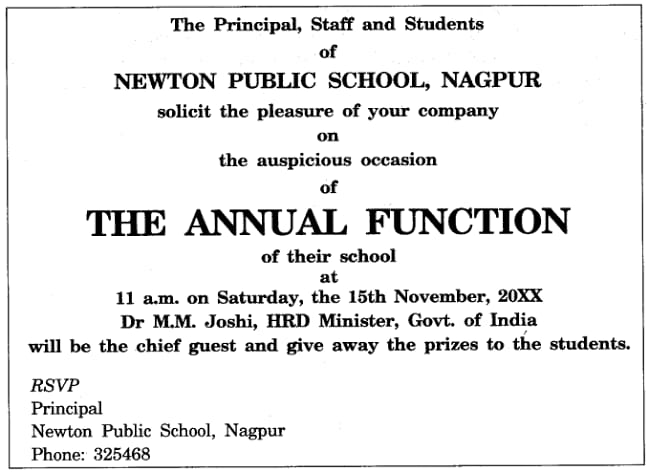
SAMPLE INVITATION CARD

 SAMPLE INVITATION CARD

You are a student of Newton Public School, Nagpur. The school is holding its annual function on Saturday, the 15th November, 20XX at 11 a.m. The HRD Minister Dr M.M. Joshi has consented to be the chief guest. Design an invitation card to be sent to the parents and other invitees. Do not exceed 50 words.


12th std INVITATION CARDS/LETTERS

 INVITATION CARDS/LETTERS


An invitation is a formal request to someone to attend any specific occasion, celebration , programme or any event.  


Types of Invitation: 

1. Formal 

2. Informal


FORMAL INVITATION 


➡️ To be written in third person


Details like address or any other instruction is written at the bottom to the left side (card)


 Subject is mandatory & generally written in the centre


 No abbreviation is to be used


Simple present tense is used


Word limit 50


 Each entry has to be mentioned in a SEPARATE LINE 


For example, 


          (a) The name of the person(s) who is/are inviting 


         (b) Formal expressions like 'request the pleasure of your company' 


         (c) Time and date of event  


         (d) Purpose and occasion of invitation. 


 ➡️ For RSVP, address and telephone no. is given at which the invitee may contact for any queries. 


Name of the Chief Guest of the programme may be given.


EXERCISE: 

1. Write a formal invitation for the marriage function of your daughter. (Formal invitation for marriage/auspicious occasion)


 2. You are a student of Modern Public School, Model Town, Noida. The School is holding its Annual Function at 5.30 p.m. on 20th Dec. 2022. The Education Minister has consented to be the Chief Guest. Design an invitation card to be sent to the parents and other invitees. (Word Limit 50).


FORMAL REPLIES (ACCEPTANCE / REFUSAL)


➡️ Points to Remember 


 Acknowledge the invitation 


 Be brief and specific  


 Express thanks in third person


 Not to be signed at the end 


 When accepting, confirm date and time 


 If declining, give reason, convey your best wishes 


 Give date and address at top left hand side 


 Use simple language • Word limit 50


FORMAL ACCEPTANCE


1. You are Mr. Ajay Gupta of 7 Park Avenue, Delhi. Draft a reply accepting an invitation to attend a house warming party hosted by your colleague.


2. You are Dr. Shailesh Gupta, an eminent educationist. You have been invited to preside over on Inter Zonal Declamation competition by Neha the President of English Literary club of Government Model Sr. Sec. School, Sector-19, Chandigarh. Write a letter of acceptance of the invitation. (To Preside / Inaugurate / Judge Events etc.) 


FORMAL REFUSAL


1. You are Mr. Ajay Gupta of 7 Park Avenue, Delhi. Draft a reply of refusal expressing inability to attend a house warming party hosted by your colleague.


2. You are Dr. Shailesh Gupta, an eminent educationist. You have been invited to preside over an Inter Zonal Declamation Competition by Neha, the President of English Literary Club of Government Model Sr. Sec. School Sector-19, Chandigarh. Write a letter for refusal of the invitation.


EXTRA ASSESSMENT

1. You are Rohit of Mysore. Prepare a formal reply expressing inability to attend the marriage of a colleague owing to a prior engagement.  (Word Limit:  50 Words) 


INFORMAL INVITATION 


Informal invitation follow the ordinary personal letters pattern. 


These letters or invitations are written to relatives, friends and known persons.


➡️  Points to Remember 


Use first person 'I', 'We' and 'You' and avoiding using 'he', 'she' and 'They' 


 Do not write subject and receiver's address.


 Write in warm and personalized style with relaxed and informal tone.


 Avoid writing unnecessary details.


 Salutation 'Dear' _________ (Name)


Body


Subscription Yours truly, ________ (Name)


  Word limit 50


Q1. You are Atanu / Aatya of 203/A, Navodaya Vihar, Delhi Write a an invitation to invite all your friends for the party you are giving to celebrate your selection in B-Tech in DTU.


203/A, Navodaya Vihar,

 Delhi 


10th Jan, 2022.


 Dear Rohit,


 I have immense  pleasure in inviting you to post-selection party after my admission in DTU. Request you to visit  my residence at 7.30 p.m. on 16 Jan, 2022 to join my family and friends in my euphoric moment. 


Yours truly, 

Atanu


INFORMAL ACCEPTANCE 


You are Rohit and have been invited to the post selection party of your friend Atanu. Write a reply accepting the invitation you got.


7-C, Yojna Vihar, 

Delhi 


10 May, 2022


Dear Atanu, 


 Many thanks for inviting me to attend your post selection party which will be held on 16th May 2022 at your home. I shall be highly delighted to attend the same and will enjoy the party with great fun & frolic. 


Yours truly,

Rohit 


INFORMAL REFUSAL 


You are Rohit and you have been invited to the post selection party of your friend Atanu. Write a reply regretting your inability to attend the same.


7-C, Yojna Vihar,

 Delhi 


10 May, 2022


 Dear Atanu,


Many thanks for inviting me to attend your post- selection party, but I regret to say that I shall not be able to attend the same as I shall be out of station next week. I shall miss this joyous occasion. I wish you all the very best for the future. God Bless You. 


Yours truly,

Rohit 


Questions for Practice ( Acceptance) 


 1. You are Vikram/Vrinda of D-23, Nirdesh Marg, Delhi. Your friend Sarah has invited you for a party to celebrate her good board result and admission to a prestigious college. Draft a reply accepting the invitation. 


Questions for Practice ( Refusal/ Acceptance)


1. Mr. and Mrs. Mehta of 352/C, Darwin colony, they has decided to have a party on the occasion of sixteenth birthday of their daughter. You are unable to attend the function. Write a reply in about 50 words.


 2. You are Siddharth / Shalini of D-209, Pragati Nagar. You have received an invitation to attend the inauguration ceremony of a newly opened shop of your friend Karan. Write a reply of acceptance.